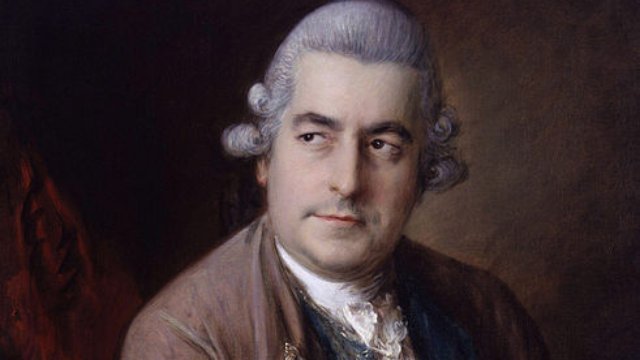
Pupil of his father (he was the third last son of Johann Sebastian, and the eleventh born from his second marriage), then of his half-brother Carl Philipp Emanuel in Berlin; here he became passionate about Italian opera to the point that we soon find him in Milan, where around 1755 he joined the orchestra of Count Litta and was sent by him to Bologna to perfect himself with the famous Father Martini. After converting to Catholicism in 1760, he obtained a position as organist at the cathedral of Milan, starting his career as an opera composer in 1761. The successes of Turin and Naples earned him the appointment as the composer of the King's Theater in London: from 1762, he lived in London, where he was also the music teacher of Queen Sofia Charlotte and where he had contact with the young Mozart, who received not negligible stimuli from his music. He was much sought after as a teacher and much applauded as a performer and conductor: but his fame faded with the change in taste, and the financial fortunes of a concert enterprise he founded changed to the point that he ended up in economic conditions far from being prosperous.
Johann Christian is the greatest symphonist among the sons of Johann Sebastian, and he is also, among the sons of the great Bach, the one who most deviated as a composer from the path taken by his parent. Father Martini, Jommelli, and all the other Italian opera players left a decisive mark on him, so much so that, unlike the other Bachs, he cultivated theatrical production with particular care.
In instrumental music, also because he is part of a generation now projected towards the 1800s, he tends to shape the orchestra with more extraordinary elegance, with a touch of Rococo corrected by a conscious absorption of the new principles introduced by the Mannheim school: hence very particular care for timbre and chiaroscuro, a resort to homophony abandoning the paternal polyphonic tradition which was now considered, by the new generations, a useless dead weight. This explains his influence on Mozart - which he was among the first to appreciate - in a refinement of the melodic taste rather than a refinement of the sonata form, which remains a distinctive contribution of the half-brother Carl Philipp Emanuel.
His instrumental production includes about fifty symphonies, thirty concertante symphonies, 13 overtures, and 37 concertos for harpsichord (or pianoforte) and orchestra.
Symphony in E flat major op. 9 n. 2 (c.1770)

It includes, next to the strings, two oboes and two comos and is notable above all for the breadth of the initial "Allegro", which has many similarities with the style of a certain Haydn.
The short "Andante con sordini" is almost Mozartian in its perfect melodic grace, while the concluding "Minuet" has all the elegance of the third movement of a classical symphony: here too, one cannot help but think of Mozart.
Symphony in B flat major op. 18 n. 2 (1772-76)
It was initially an overture for the opera Lucio Silla, staged in Mannheim in 1776: it, therefore, retains the fluency and elegance a little superficial, a monodic even Mozartian taste, a vivacity of the instrumental treatment that is peculiar to Johann Christian. Note above all the final "Presto", preceded by an "Allegro molto" and an "Andante."
Piano Concertos Op. 7
Bach's concertos that make up his Opus 7 were published in 1770 under the title "Six Concertos for the Harpsichord or Piano Forte with accompaniments for two violins and a cello". It was not uncommon to advertise works for both instruments in that transitional period between the harpsichord and the piano. On the one hand, it could increase sales to people who did not yet have the new pianos, but it also reflected that the piano had not yet developed an idiomatic style distinct from that of the harpsichord.
Bach himself is said to have performed piano concerts as early as 1768, but he is also known to have served on the harpsichord in the early 1970s. Three of these six concertos have dynamic signs that would suggest playing on a piano: forte signs under just a few notes to emphasize them and progressively loud dynamic signs to indicate a crescendo. For at least these three concerts, the piano would seem to be the preferred instrument, but the works in this set have been successfully performed on both the harpsichord and the piano.
The publisher's title suggests that these are essentially chamber pieces with just three-stringed instruments accompanying the keyboard soloist. That said, there may have also been performances with a larger ensemble. Horn parts for five of these concerts (all except No. 4), as well as oboe parts for No. 3, were discovered at the end of the twentieth century and appear to be authentic. and oboe parts for No. 3 While the chamber nature of these works would have made them attractive to amateurs playing at home, a more orchestral ver,sion may have been useful for the famous concert series that Bach produced in London alongside the gambler and composer Carl Friedrich Abel.
In them, the piano is treated essentially as a monodic instrument. In this lies the significant difference of Johann Christian from his father, that aspect of novelty that brings his work closer to that of Mozart.
And Mozart is often the line of his melodies and the purity of his sonority. The Concerto in E flat major no. 5.
Piano Concertos Op. 13
:format(jpeg):mode_rgb():quality(90)/discogs-images/R-14649528-1578890566-4956.jpeg.jpg)
Johann Christian's ability to make the new fortepiano his own gained even more favor in public circles. Indeed, while Clementi was still playing the old harpsichord in London, Johann Christian captivated his audience with the new keyboard. Composed in the 1770s, his keyboard concertos represent some of the best examples of all of his keyboard works and incorporate everything that was admired in their days. All in three movements, the traditional fast - slow - fast, they are stylish and elegant, graceful and gallant. Johann Christian courted his audience using the grace and charm of the Italian style, involving and intertwining the folk elements of his adopted country. There was no best way to please the Queen!
The Concerto in D major, op.13, n.2, is the second of six piano concertos published in 1777, with the title: “A Third Sett of Six Concertos for the Harpsichord, o Pianoforte. With accompaniments for two violins and bass, two Hautboys, and two French horns ad libitum. Humbly dedicated to Mrs. Pelham and composed by the music teacher John Christian Bach to her Majesty the Queen of Great Britain ”.John Christian Bach's music teacher was customary in all his piano concerts to play figured bass in orchestral passages.
The piano plays everywhere: it plays the figured bass to accompany the orchestra and its own solo part. We can say that this Concerto undoubtedly represents the best of this musician's extensive piano production.
The Concerto in B flat, Op.13, n.4, is the fourth of the same group. It was a favorite of the set in its time and was made even more special when Haydn arranged it for solo piano ten years after Bach's death. This piece had great public appeal; it was not only the charm of the gallant and song-like tenderness of the slow movement, but the ensemble of variations that Johann Christian composed for the third movement based on the Scottish song, The Yellow-haired Laddie.
The other two concertos on this record have been attributed to Johann Christian Bach and have always been believed to be composed by him around the years 1770/1771 as part of the Opus 7 keyboard concert set, different from the Opus 13 concerts, and while rehearsing these pieces, we took turns trying to decide who the composer might be because they didn't feel or sound like Johann Christian. Both concerts sound like C.P.E. Bach or like the Symphonies of Johann Christoph Friedrich, with a brilliance and a melodic buoyancy that prevails. Simple, if not a bit old-fashioned, they are certainly undoubtedly fun concerts.
It made me realize that while, by today's modern piano standards, Johann Christian's work may seem too simple, it was pretty forward-looking in his day. It was rather forward-looking in his day. The differences between Opus 13 and these concerts became more and more evident. Another difference that comes to mind is the score. These concerts include a viola as part of the orchestra, while Opus 13 is composed only for two violins and a cello, with the optional wind.
After some research, I found that both of these concerts are now thought to be composed by Johann Christoph Friedrich Bach, who made a career at the cultured court of Count William of Schaumburg-Lippe in Bückeburg, thus unraveling the mystery for us (see Collected Works of JC Bach, ed. Ernest Warburton). These concerts were published by Hartknoch of Riga in the 1770s. In his catalo Warburton catalog informs us that “Ulrich Leisinger has now proved beyond reasonable doubt that the true composer of the Concerto in E flat is J.C.F. Bach ", and the Concerto in A, the second of Hartknoch's two concertos, is now also known to be by Johann Christoph Friedrich. What evolved from the exercise was how groundbreaking Johann Christian's music was, and clearly, I could see why he continued to gain favor as a composer. His music marked the link between baroque and classical; it established the foundation upon which classicism would flourish and, of notable importance, was music particularly suited to its social purpose. This, in the eighteenth century, was a recipe for success.
(P.zza%20Vittorio%20Emanuele%20II)%20(1977).jpg)
.JPG)
.jpg)
(Le%20Torri)%20(1977).jpg)
(P.zza%20Vittorio%20Emanuele%20II)%20(1977).jpg)
.jpg)
(Le%20Torri)%20(1977).jpg)